Showing posts with label Nissan. Show all posts

Tuesday, August 23, 2011

Nissan Cube

The Nissan Cube is a Mini MPV produced by Nissan for the Japanese market since 1998, and now sold in export markets such as North America and Europe.


Exotic Nissan Cube With White Diamond Color


Luxury Nissan Cube


The first generation of the Cube (designated Z10) was introduced in 1998. It shared the same platform as the Nissan Micra (known as the March in Japan and Southeast Asia), as well as the same 1.3 L engine. A CVT gearbox and four-wheel drive were optional. The Cube covered the gap in the Nissan lineup between the March and the Sunny. The first generation was sold only in Japan, though privately exported to United Kingdom, Australia and Hong Kong.


Nissan Cube Interior View


The second generation of the Cube, released in 2002 with a larger interior than the previous model. The combination of angled and curved surfaces was based on the third generation of the March, powered by a 1.4 L I4 engine. The model included the "e4WD" system as an option, which transfers power to the rear wheels when the front wheels spin via a small electric motor on the rear underside of the floor. The electrically powered system allows for reduced drivetrain drag when only driving in FWD mode.


In 2008, Nissan revealed the Nissan Denki (Japanese for “electric”) Cube Concept. Making its debut at the March 2008 New York International Auto Show, the Denki Cube Concept is a lithium-ion battery-powered electric vehicle. Nissan’s compact lithium-ion battery technology provides batteries with twice as much energy compared with a conventional cylindrical battery of the same type.


The Denki Cube Concept also serves as a preview of Nissan’s future plans to sell a redesigned gasoline-powered (would be a new generation) Cube at Nissan dealers in the United States and Canada beginning in 2009 (called Nissan EV). Prototypes have been test driven by journalists and reports published in spring 2009.


Nissan Cube Back Side View


The third generation Nissan Cube was revealed for the first time at the Los Angeles International Auto Show, on November 19, 2008. While this is the third generation of the vehicle, it is being offered for export markets, including European and North American markets, for the first time. The Cube went on sale in Japan on November 19, 2008 and the U.S. on May 5, 2009.


Friday, August 12, 2011

2012 Nissan Altima Coupe : Latest Reviews


It’s arguably getting on years (count five since any significant update), but the Altima continues to sell quite well. And when such a formula proves successful, there’s very little reason to change it.

For 2012, updates on Nissan‘s sporty, front-drive mid-size sedan and coupe are relatively few. The biggest is the so-called Value Package, essentially a technology option that adds auto dimming headlights, rear view mirror, leather wrapped steering wheel with built in audio controls and Bluetooth functions, all for $490.

In terms of pricing, the Altima 2.5 stickers at $20,410, excluding destination charges, while the 2.5 S equipped with the CVT begins at $22,570, a hike of some $140 over last year. Meanwhile the full-tilt 3.5 SR CVT, will cost you $25,430, which is $320 more than the outgoing model.

On the coupe front things are quite interesting, buyers actually have to pay more for a stick-shift – $30,760 for the 3.5 R six-speed, versus $28,430 for the CVT equipped version.

Thursday, July 14, 2011

New Gen Y Buyer Survey Spells Trouble for Detroit


Auto pricing website TrueCar studied the car buying behaviour of four million Gen Y (18 to 27 year-old) over a twenty-four month period and here’s what they found.
Scion took the crown for top brand, with 37.4% of the market and for top model (the tC coupe), with 21.2%, while second place went to Mitsubishi (32.1%) and their Lancer sedan (20.3%).
Mazda was the third most visited brand for Gen Y buyers, though only 17th in terms of model. The top four vehicle choices were Japanese, with a German in seventh place and a South Korean in ninth.

New Gen Y Buyer Survey Spells Trouble for Detroit


Auto pricing website TrueCar studied the car buying behaviour of four million Gen Y (18 to 27 year-old) over a twenty-four month period and here’s what they found.
Scion took the crown for top brand, with 37.4% of the market and for top model (the tC coupe), with 21.2%, while second place went to Mitsubishi (32.1%) and their Lancer sedan (20.3%).
Mazda was the third most visited brand for Gen Y buyers, though only 17th in terms of model. The top four vehicle choices were Japanese, with a German in seventh place and a South Korean in ninth.

Video: Nissan LEAF Climbs the Pikes Peak


Last month, Nobuhiro “Monster” Tajima broke his own record at the Pikes Peak Hill Climb with a sub 10 minutes time in a 910-horsepower modified Suzuki SX4 racecar.
Now, Nissan’s first all-electric car, the LEAF, has tackled the 156 turns of the “Race to the Clouds”. Naturally, “Monster” Tajima can rest assured that his record remains safe.
That’s not to say that the LEAF driven by Chad Hord didn’t record a respectable time. After all, 14 minutes and 33 seconds with an average speed of 51.2 mph (82.4 km/h) is not to be laughed at for an EV that used just 46% of its charge to cover the demanding 12.42 miles (20 km) hill climb.
Watch the LEAF climb the Pikes Peak after the jump.

Video: Nissan LEAF Climbs the Pikes Peak


Last month, Nobuhiro “Monster” Tajima broke his own record at the Pikes Peak Hill Climb with a sub 10 minutes time in a 910-horsepower modified Suzuki SX4 racecar.
Now, Nissan’s first all-electric car, the LEAF, has tackled the 156 turns of the “Race to the Clouds”. Naturally, “Monster” Tajima can rest assured that his record remains safe.
That’s not to say that the LEAF driven by Chad Hord didn’t record a respectable time. After all, 14 minutes and 33 seconds with an average speed of 51.2 mph (82.4 km/h) is not to be laughed at for an EV that used just 46% of its charge to cover the demanding 12.42 miles (20 km) hill climb.
Watch the LEAF climb the Pikes Peak after the jump.

Tuesday, July 5, 2011

Nissan Pathfinder

The Nissan Pathfinder is a SUV manufactured by Nissan Motors since 1986, derived from Nissan's compact pickup truck platform. The Pathfinder is slotted in size between the Murano and Armada or Patrol, but in price between the Xterra and Murano. The Pathfinder's traditional Japanese competitor is the Toyota 4Runner.The North American first generation Pathfinder came in two different bodies and shared styling and most components with the Nissan Hardbody Truck. Built on a ladder-type frame, the Pathfinder was Nissan's response to the Chevrolet Blazer, Ford Bronco, Jeep Cherokee, and non-American SUVs like the Toyota 4Runner, Isuzu Trooper, and the Mitsubishi Montero. WD21 Pathfinders were available in both 2WD and 4WD configurations. In the US from 1986.5 to 1989 Pathfinders came with a two door body. In early 1990 it became a four door in the United States. Some US 1990 Pathfinder's came with the two door body, but they are rare. Before the Pathfinder there was the Nissan Bushmaster (an aftermarket conversion of the Datsun Truck,) but this too, is rare. When the four door version was introduced, Nissan chose to conceal the door handles as a part of the "C" pillar trim to visually make it appear like a two door truck with a camper shell, with the conventional door handles on the front doors. This appearance approach was also used on the first generation Chevrolet S-10 Blazer with conventional door handles for the rear doors. This design tradition is still used on some Nissan SUV's currently offered, to include the Nissan Armada and the Nissan Xterra. The 2-door version was available in Canada until 1990. From 86.5 to 1989 Pathfinders were available with either the Nissan VG30i 3.0 L V6 (145 hp (108 kW), 180 lb·ft (244 N·m) torque), or the Nissan Z24i 2.4 L (106 hp (79 kW)) I4 (The same engine choices as the Nissan Hardbody Truck.) In 1990 the V6 received an upgrade from throttle body injection to a multi point fuel injection system. This engine was known as the VG30E, and was rated at 153 hp (114 kW) and 180 lb·ft (244 N·m) torque. Also in 1990, the Z24i was replaced with the KA24E. The first generation continued until 1995. In certain countries this generation also came with a 2.7 L I4 Diesel Engine known as the TD27 with the option of a turbocharger to increase the power rating.


2011 Nissan Pathfinder Review

The second generation was introduced in 1996 with more rounded styling. The second generation Pathfinder was completely redesigned from the first generation, switching from body on frame construction to unibody construction. The engine was upgraded to the VG33E, with 168 hp (125 kW) and 196 lb·ft (266 N·m) torque. For the 1999½ model year, the Pathfinder was freshened. 2001 brought a new 240 hp (179 kW) V6 engine, the VQ35DE. With its facelift, the Pathfinder also grew in size, making way for the compact Xterra. Diesel engines continued to be used in Japanese and European models. As of the 2002 model year, the Terrano / Pathfinder is no longer sold in Japan, and is currently available in North America, Europe and the Middle East. Nissan has issued a TSBS (Technical Service Bulletin) on the issue (NTB908-001, NTB098-012), but has not dealt with it as a recall. It is an expensive fix ($700-1,400) repair due to faulty control arm bushings. A Polyurethane after-market bushing replacement is suggested over the OEM part (since it is faulty). Their TSB website says: "If a 1996-98 Pathfinder exhibits the following conditions, the cause may be from worn bushing(s) in the rear suspension upper and/or lower links. Excessive play in the rear axle especially during moderate acceleration or deceleration. Vehicle pulling at a constant speed. Excessive sway and rocking motion in the front suspension when coming to a stop. To correct these conditions, use the service procedure on page 2". Many customers have complained of this issue happening at highway speeds 55 mph+ which causes the vehicle to sway back and forth dangerously. NTSB "complaint" board has numerous owners that have complained about the problem but Nissan has not addressed the design flaw or issued notices or recalls to the owners. The Pathfinder was given a face lift in 2001 with a new front fascia two grille variants, rear fascia, and interior. Another face lift occurred in 2002, when the current Nissan logo was added and received a bolder grille versus the 2000 model, as well as a new steering wheel and radio display.

At the 2004 North American International Auto Show, Nissan unveiled a completely redesigned Pathfinder for the 2005 model year. The new R51 Pathfinder uses the Nissan F-Alpha platform, and is powered by a 4.0 L V6 engine VQ40DE (266 hp (198 kW), 288 lb·ft (390 N·m)) or a 2.5 L YD25DDTi (174 hp (130 kW), 297 lb·ft (403 N·m)) Turbo Diesel. In late 2003, a full-size SUV, the Pathfinder Armada, debuted. Although they share a common name, they have little similarity and use different platforms. The "Pathfinder" prefix was dropped for 2005, leaving just the name "Armada". The Pathfinder is sold as the Terrano in many markets outside of North America. In 2005, when the redesigned Pathfinder was released the Pathfinder name became international as it sold worldwide. These were the first to be sold in the UK. The 2005 model introduced a third row of seats to the Pathfinder line for the first time. It has been subject to a class action lawsuit because of repeated coolant leaks that permanently damage the transmission. The facelifted 2008 Nissan Pathfinder debuted at the 2007 Chicago Auto Show, and added new models with a V8 engine from the related Nissan Titan. An updated version debuted at the Geneva Motor Show in 2010. Now available with a Nissan 3.0-litre V6 Turbodiesel (V9X Engine) producing 240 hp (175 kW),406 ft·lbf (500 Nm) @ 2,500 rpm while an upgrade YD25DDTi Turbodiesel power rises to 140 kW (190 PS) – up 14 kW (19 PS) – while torque increases by a healthy 47 Nm to 450 Nm. Over the combined cycle manual versions use 8.4 L/100km – an improvement of 1.4 L/100km – while CO2 emissions have fallen by 40g/km to 224 g/km. Both figures are class competitive. A version of the engine with a diesel particulate filter (DPF) is also available in certain markets. Exterior changes. The revised models have been given a new look front and rear to differentiate them from their predecessors. Changes at the front include a new bonnet, revised grille and a new bumper assembly. Adding 80 mm to the length of both models, the bumper is more rounded and lends a more sporting touch to the cars. A new headlamp design with projectors is offered for Xenon lamps. Headlamps washers now pop up from beneath body colour moulding in the bumpers. A new 18-inch (460 mm) alloy wheel complements the existing range of 16 inch (steel and alloy) and 17 inch (alloy) designs. V6 models are given a discreet V6 badge at the leading edge of both front doors and a new side moulding across the doors.

Nissan Pathfinder

The Nissan Pathfinder is a SUV manufactured by Nissan Motors since 1986, derived from Nissan's compact pickup truck platform. The Pathfinder is slotted in size between the Murano and Armada or Patrol, but in price between the Xterra and Murano. The Pathfinder's traditional Japanese competitor is the Toyota 4Runner.The North American first generation Pathfinder came in two different bodies and shared styling and most components with the Nissan Hardbody Truck. Built on a ladder-type frame, the Pathfinder was Nissan's response to the Chevrolet Blazer, Ford Bronco, Jeep Cherokee, and non-American SUVs like the Toyota 4Runner, Isuzu Trooper, and the Mitsubishi Montero. WD21 Pathfinders were available in both 2WD and 4WD configurations. In the US from 1986.5 to 1989 Pathfinders came with a two door body. In early 1990 it became a four door in the United States. Some US 1990 Pathfinder's came with the two door body, but they are rare. Before the Pathfinder there was the Nissan Bushmaster (an aftermarket conversion of the Datsun Truck,) but this too, is rare. When the four door version was introduced, Nissan chose to conceal the door handles as a part of the "C" pillar trim to visually make it appear like a two door truck with a camper shell, with the conventional door handles on the front doors. This appearance approach was also used on the first generation Chevrolet S-10 Blazer with conventional door handles for the rear doors. This design tradition is still used on some Nissan SUV's currently offered, to include the Nissan Armada and the Nissan Xterra. The 2-door version was available in Canada until 1990. From 86.5 to 1989 Pathfinders were available with either the Nissan VG30i 3.0 L V6 (145 hp (108 kW), 180 lb·ft (244 N·m) torque), or the Nissan Z24i 2.4 L (106 hp (79 kW)) I4 (The same engine choices as the Nissan Hardbody Truck.) In 1990 the V6 received an upgrade from throttle body injection to a multi point fuel injection system. This engine was known as the VG30E, and was rated at 153 hp (114 kW) and 180 lb·ft (244 N·m) torque. Also in 1990, the Z24i was replaced with the KA24E. The first generation continued until 1995. In certain countries this generation also came with a 2.7 L I4 Diesel Engine known as the TD27 with the option of a turbocharger to increase the power rating.


2011 Nissan Pathfinder Review

The second generation was introduced in 1996 with more rounded styling. The second generation Pathfinder was completely redesigned from the first generation, switching from body on frame construction to unibody construction. The engine was upgraded to the VG33E, with 168 hp (125 kW) and 196 lb·ft (266 N·m) torque. For the 1999½ model year, the Pathfinder was freshened. 2001 brought a new 240 hp (179 kW) V6 engine, the VQ35DE. With its facelift, the Pathfinder also grew in size, making way for the compact Xterra. Diesel engines continued to be used in Japanese and European models. As of the 2002 model year, the Terrano / Pathfinder is no longer sold in Japan, and is currently available in North America, Europe and the Middle East. Nissan has issued a TSBS (Technical Service Bulletin) on the issue (NTB908-001, NTB098-012), but has not dealt with it as a recall. It is an expensive fix ($700-1,400) repair due to faulty control arm bushings. A Polyurethane after-market bushing replacement is suggested over the OEM part (since it is faulty). Their TSB website says: "If a 1996-98 Pathfinder exhibits the following conditions, the cause may be from worn bushing(s) in the rear suspension upper and/or lower links. Excessive play in the rear axle especially during moderate acceleration or deceleration. Vehicle pulling at a constant speed. Excessive sway and rocking motion in the front suspension when coming to a stop. To correct these conditions, use the service procedure on page 2". Many customers have complained of this issue happening at highway speeds 55 mph+ which causes the vehicle to sway back and forth dangerously. NTSB "complaint" board has numerous owners that have complained about the problem but Nissan has not addressed the design flaw or issued notices or recalls to the owners. The Pathfinder was given a face lift in 2001 with a new front fascia two grille variants, rear fascia, and interior. Another face lift occurred in 2002, when the current Nissan logo was added and received a bolder grille versus the 2000 model, as well as a new steering wheel and radio display.

At the 2004 North American International Auto Show, Nissan unveiled a completely redesigned Pathfinder for the 2005 model year. The new R51 Pathfinder uses the Nissan F-Alpha platform, and is powered by a 4.0 L V6 engine VQ40DE (266 hp (198 kW), 288 lb·ft (390 N·m)) or a 2.5 L YD25DDTi (174 hp (130 kW), 297 lb·ft (403 N·m)) Turbo Diesel. In late 2003, a full-size SUV, the Pathfinder Armada, debuted. Although they share a common name, they have little similarity and use different platforms. The "Pathfinder" prefix was dropped for 2005, leaving just the name "Armada". The Pathfinder is sold as the Terrano in many markets outside of North America. In 2005, when the redesigned Pathfinder was released the Pathfinder name became international as it sold worldwide. These were the first to be sold in the UK. The 2005 model introduced a third row of seats to the Pathfinder line for the first time. It has been subject to a class action lawsuit because of repeated coolant leaks that permanently damage the transmission. The facelifted 2008 Nissan Pathfinder debuted at the 2007 Chicago Auto Show, and added new models with a V8 engine from the related Nissan Titan. An updated version debuted at the Geneva Motor Show in 2010. Now available with a Nissan 3.0-litre V6 Turbodiesel (V9X Engine) producing 240 hp (175 kW),406 ft·lbf (500 Nm) @ 2,500 rpm while an upgrade YD25DDTi Turbodiesel power rises to 140 kW (190 PS) – up 14 kW (19 PS) – while torque increases by a healthy 47 Nm to 450 Nm. Over the combined cycle manual versions use 8.4 L/100km – an improvement of 1.4 L/100km – while CO2 emissions have fallen by 40g/km to 224 g/km. Both figures are class competitive. A version of the engine with a diesel particulate filter (DPF) is also available in certain markets. Exterior changes. The revised models have been given a new look front and rear to differentiate them from their predecessors. Changes at the front include a new bonnet, revised grille and a new bumper assembly. Adding 80 mm to the length of both models, the bumper is more rounded and lends a more sporting touch to the cars. A new headlamp design with projectors is offered for Xenon lamps. Headlamps washers now pop up from beneath body colour moulding in the bumpers. A new 18-inch (460 mm) alloy wheel complements the existing range of 16 inch (steel and alloy) and 17 inch (alloy) designs. V6 models are given a discreet V6 badge at the leading edge of both front doors and a new side moulding across the doors.

Saturday, June 25, 2011

2011 Nissan Versa

The 2011 Nissan Versa is the best car for you if driving a good small car now is more important than waiting for a replacement you hope is as capable, efficient, and affordable. The 2011 Nissan Versa is largely a carryover from the 2010 Nissan Versa, though the important safety advantage of an antilock braking system (ABS) becomes standard instead of optional on more models. The 2011 Versa will continue as a cleverly packaged five-passenger auto that competes with smaller subcompact cars on price but with larger compact cars for passenger and cargo room. Versa was introduced for model-year 2007, supplanting the Sentra as Nissan’s entry-level car. Nicer to look at and better to drive than the Sentra, it’s gone on to outsell its more established sibling, and now Nissan is preparing to introduce the second-generation Versa. The company is mum on details, but it appears the redesigned Versa will go on sale during 2011 as a 2012 model.

Impressive Green 2011 Nissan Versa

Elegant 2011 Nissan Versa In Red Color

2011 Nissan Versa View Detail

Black 2011 Nissan Versa

2011 Nissan Versa Hatchback

White 2011 Nissan Versa Side View

2011 Nissan Versa Engine Detail

2011 Nissan Versa Dashboard

2011 Nissan Versa Seats View

2011 Nissan Versa Baggage

Sporty 2011 Nissan Versa Back View

2011 Nissan Versa

The 2011 Nissan Versa is the best car for you if driving a good small car now is more important than waiting for a replacement you hope is as capable, efficient, and affordable. The 2011 Nissan Versa is largely a carryover from the 2010 Nissan Versa, though the important safety advantage of an antilock braking system (ABS) becomes standard instead of optional on more models. The 2011 Versa will continue as a cleverly packaged five-passenger auto that competes with smaller subcompact cars on price but with larger compact cars for passenger and cargo room. Versa was introduced for model-year 2007, supplanting the Sentra as Nissan’s entry-level car. Nicer to look at and better to drive than the Sentra, it’s gone on to outsell its more established sibling, and now Nissan is preparing to introduce the second-generation Versa. The company is mum on details, but it appears the redesigned Versa will go on sale during 2011 as a 2012 model.

Impressive Green 2011 Nissan Versa

Elegant 2011 Nissan Versa In Red Color

2011 Nissan Versa View Detail

Black 2011 Nissan Versa

2011 Nissan Versa Hatchback

White 2011 Nissan Versa Side View

2011 Nissan Versa Engine Detail

2011 Nissan Versa Dashboard

2011 Nissan Versa Seats View

2011 Nissan Versa Baggage

Sporty 2011 Nissan Versa Back View

Saturday, April 23, 2011

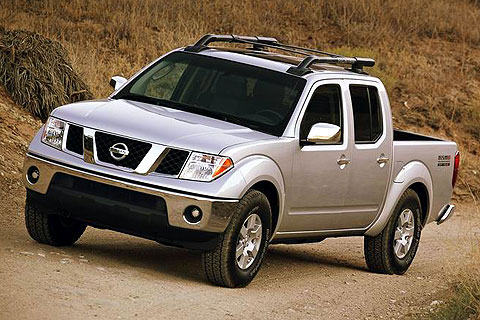
Nissan Frontier

Nissan Frontier is the name for the D22 and D40 generations of Nissan pickup trucks in North, Central and South America and the Philippines. The line was started in 1998, and its immediate predecessor is the D21 Nissan Hardbody truck. As of 2002, the D22 series Nissan Truck is no longer sold in Japan, with the primary market having been relocated to North America, built at the Smyrna, Tennessee Nissan factory. Nissan was the pioneer of the Hardbody or Nissan Navara since 1986. The first was the D21, considered to be a small pick up. After more than 10 years with the D21, the second generation Navara was manufactured from 1998 and went until 2005 which was classed as a compact sized pick up. It was replaced with the bigger, taller, longer D40, which Nissan now considers to be a mid-size pick up truck. The Navara gets its name from the Navarre region of northern Spain, and the European version is built at the Nissan factory in Barcelona. The Frontier was introduced in 1997 for the 1998 model year as a replacement for the aging 1986.5–1997 Nissan Hardbody Truck. Nissan first offered the Frontier with a 4-cylinder engine, the KA24DE, but added the V6 engine, the VG33E in 1999. Elsewhere, the Frontier was also known as the Nissan Navara. That changed, with the introduction of the 2000 Frontier Crew Cab. The Crew Cab was the first compact pickup to offer a 4-door body-style in North America. Until that point, crew cabs were heavy duty versions of full-size trucks and were mainly used as commercial vehicles, although four-door compact pickups existed in Asia and Europe for decades. For 2001, Nissan facelifted the Frontier, introducing bolder styling in an effort to make it more appealing to younger buyers in its second generation. The Frontier was completely redone after the 2004 model year, which later resulted in the suspension of the regular cab model, indefinitely.


The first Gen Frontier (2001–2004) was not sold or produced in Japan. Sales and production started in North America, with Crew Cab and King Cab versions and new grille, bumper, headlights, taillights, built in fender flares, and tailgates. Available engines include a petrol 2.4L, 3.3L, and a 3.3L Supercharged version 210 hp (160 kW). It is available with both 2 wheel and 4 wheel drive. The plant in Spain replaced production in Japan. They began exporting the second generation to Central and South America where it is called Frontier. Single Cabs and Crew Cabs are available with the Petrol or Diesel engines, 2wd and 4wd. Also in Australia and New Zealand. Brazil plant started production around 2002 (Crew Cab Diesel 2wd or 4wd, 5 speed manual, or single cab 2wd Diesel. Only for export to Mexico petrol 2.4 cc Built in Mexico) and export to Argentina (all Brazilians versions) and Mexico (Crew Cab, Petrol 2.4L, 2wd, Manual 5 speed). Egypt Plant export to Middle East, South Africa Plant to African countries. Mexico production, starting in 2008: D22 truck Single Cab Chassis and Long Bed (2wd or 4wd, Petrol 2.4L or Diesel, Crew Cab (2wd and Petrol) called D22 Pick up, Nissan Mexicana import from USA D40 Frontier V6. Initially, the Frontier was considered a compact, but beginning with the totally redesigned model year 2005 Frontier (introduced at the 2004 North American International Auto Show), it became more mid-sized. It uses the new Nissan F-Alpha platform and exterior body styling resembles that of the company's full-size Nissan Titan truck. The new truck's wheelbase is 125.9 in (3.20 m) with a 205.5 in (5.22 m) overall length. Towing capacity is 6500 lb (2,950 kg). A 4.0 L VQ-family V6, the VQ40DE, is the standard engine, and it produces a respectable 265 hp (198 kW) with 284 ft·lbf (385 N·m) of torque. Also available is the QR25DE four-cylinder engine, which is also found in the Nissan Altima. A six-speed manual is standard with a five-speed automatic optional. Both rear and four-wheel drive are available. Traction control and hill-descent control are also available. The Frontier is called Navara when sold in Europe. The engine is a 2.5 L YD25DDTi diesel, with 142 hp (106 kW) or 172 hp (128 kW). The stronger version has 403 N·m (297 lb·ft) of torque.


Nissan has released the complete details and images of the 2010 Nissan Navara facelift along with the 2011 Nissan Pathfinder facelift. The 2010 Nissan Navara facelift are now powered by a new 3.0-litre V6 turbo V9X Engine diesel engine producing 240 hp (175 kW),406 lb-ft (500 Nm) @ 2,500 rpm and a revised 2.5-litre dCi unit(YD25DDTi High Power). The 2011 Nissan Navara and Pathfinder facelift V6 develop 170 kW (231 PS) and 550 Nm of torque between 1,700 rpm and 2,500 rpm an the famous YD engine which produces 190 PS (140 kW) and 450 Nm of torque an the VQ40DE remains the same with the 265 hp @5600 rpm; 291 ft·lbf (395 N·m) @4000 rpm. There are subtle changes to the headlights and the bonnet. The v-shaped grille shell is less pronounced and the bumper is rounder and projects 80mm further forward, but it's the six-spoke 17-inch alloy wheels or optional 18-inch alloy wheels that will be the plainest tell-tale to the new vehicle's identity. Inside the new Navara (top of the line model), Nissan designers have specified softer materials of a better quality for the dash, seats and interior moulds. The centre console and fascia designs have been revised, as have the instrument binnacle layout and door trims. Additional bright/gloss finish surfacing is used throughout the cabin. The six-stack CD audio system or the TV Navigation entertainment console is upgraded with speed-sensing volume, MP3 compatibility and Bluetooth connectivity for the (six-stack CD audio system). Other new or revised features include dual-zone climate control, remote audio/Bluetooth/trip computer controls on the steering wheel, trip computer, external temperature gauge, speed-sensitive variable windscreen wipers and 'follow me home' lighting. The electric mirrors now fold in fully for car washes or parking in narrow spaces. The Frontier is known as Nissan Navara in most of Europe and Australia and New Zealand, and Nissan Terrano in Chile (only D40 series is known as Navara). It is currently built in Smyrna, Tennessee, Spain, South Africa, Thailand, Philippines, China, Mexico, Brazil and Egypt.The D40 Navara has undergone Euro NCAP crash testing along with the Mitsubishi Triton and Isuzu D-Max, and received one star with a strikeout; however, after retesting with upgraded computer software it went from the lowest in the group to the highest (overall) with 3 stars. Among the problems discovered during the test was delayed airbag deployment and insufficient seatbelt restraint, which were solved with the software upgrade.